By using MoodChangeMedicine.com, you agree to accept this website’s terms of use, which can be viewed here.
May 25, 2024
By Joie Meissner ND, BCB-L
TRYPTOPHAN SAFETY SNAP SHOT

- Two international, professional organizations concluded—based on high-quality evidence—that tryptophan has “acceptable safety data.”
- Doses up to 5 grams a day as a supplement have been used safely for up to 21 days.
- Tryptophan supplements appear to carry fewer serious health risk than pharmaceutical sleep meds like Ambien, over-the-counter drugs containing diphenhydramine like Nytol, and anti-anxiety drugs like Xanax.
- Tryptophan is not addictive and does not appear to cause tolerance or withdrawal symptoms like Ambien and benzodiazepenes like Valium. Tryptophan doesn’t cause rebound insomnia. When used short-term, it’s likely a safer alternative to the pharmaceuticals.
- Medicinal doses of tryptophan greater than that found in foods, may cause respiratory depression (slowed breathing) in the developing fetus. It is unknown how it could affect developing infants whose mothers take tryptophan supplements during breast-feeding.
- Tryptophan can act as a sedative and like other sedatives, it might cause slowed breathing and sleepiness.
- Theoretically, tryptophan might have additive effects when used with alcohol, or sedating medications or supplements. Use of sedatives with tryptophan could further impair one’s ability to drive or operate machinery.
- Taking tryptophan with serotonin-boosting antidepressants such as SSRIs, mood stabilizers like lithium or other drugs or supplements that boost serotonin might rarely lead to excess serotonin, which could cause serious and potentially life-threatening side effects.
- Like all supplements, tryptophan might contain harmful impurities. Some supplement manufacturers provide certificates of analysis to safety-conscious consumers upon request.
Tryptophan might interact with other drugs or cause other adverse events or side effects not mentioned above. The above snapshot does not include all possible health conditions that could be impacted by taking tryptophan supplements. Those considering taking tryptophan should first consult with their doctor.
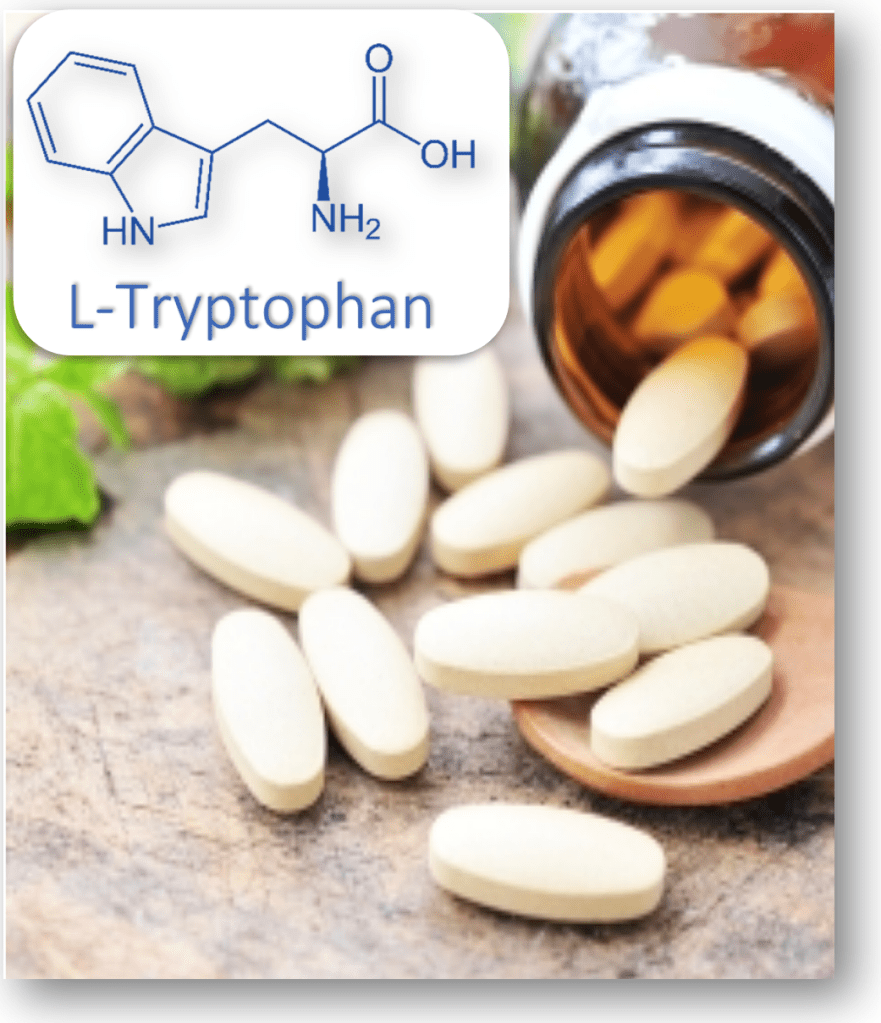
A typical American gets about 0.5-2 grams of tryptophan from their diet per day. 1
Doses up to 5 grams a day as a supplement have been used safely for up to 21 days, according to expert, peer-reviewed report from NatMed Pro. 2, 3 So it appears that these experts give tryptophan safety a short, 21-day time limit in which people can safely take the supplement.
The National Library of Medicine’s MedlinePlus concurs with that time limit stating: “there isn’t enough reliable information to know if L-tryptophan is safe when taken for more than 3 weeks.” 4
In contrast to the above authoritative sources, another authoritative source consisting of international, expert organizations concluded—based on high-quality evidence—that tryptophan has “acceptable safety data.” 5 This group of experts do not give tryptophan supplements any time limits in terms for the safety of taking this supplement.
In line with the later group of experts, a 2012 review article in The Journal of Nutrition concludes that tryptophan is safe without putting a limit on how long it can be taken safely. The article reports that people have been taking tryptophan in supplements for over five decades with just occasional modest, short-lived side-effects. Though it notes that the database upon which this assumption is based is small and largely anecdotal.
Medicinal doses of tryptophan, greater than that found in foods, may cause respiratory depression (slowed breathing) in the developing fetus, so may be unsafe for pregnant women. It is unknown how it could affect developing infants whose mothers take tryptophan supplements during breast-feeding.
So, based on the available evidence, tryptophan supplements appear to be safe if one sticks with the dosage and time limitations discussed above. Though it may not be safe in all people.
While tryptophan is “generally well tolerated”, its most common side-effects include belching, drowsiness, dry mouth, flatulence, headache, heartburn, lightheadedness, diarrhea, nausea, vomiting, stomach pain and visual blurring. 6
The reputation of tryptophan supplements has been impacted by an event that occurred in the late 90’s where thousands where sickened related to eosinophilia-myalgia syndrome (EMS). According to an expert, peer-reviewed report from NatMed Pro “almost all cases were traced to L-tryptophan produced by a single manufacturer in Japan and are likely related to contamination”. 7
Any given supplement can contain harmful impurities. Safety-conscious supplement manufacturers use spectrometry or other proven methods to batch test their final products for purity and potency. The most reputable companies use third-party testing of the final product and some offer a certificate of analysis to consumers.
Tryptophan’s safety profile is superior to that of commonly prescribed sleep meds, which can also be addictive and create rebound insomnia when discontinued. Its safety appears to be superior to common, over-the-counter sleep drugs containing diphenhydramine.
Tryptophan does not appear to be addictive or cause people to develop tolerance with long-term use. There’s typically no impairment in motor, cognitive or memory performance or increased difficulty waking up the morning after using it, 8, 9 all of which can occur with sleep medications.
Tryptophan might cause other adverse events or side effects. The above summary is not a list of all possible side effects or health conditions that could be impacted by tryptophan. Those considering taking tryptophan should first consult a qualified healthcare provider before stopping or starting any medication or supplement.
To find out more about tryptophan’s potential interactions with drugs and supplements, click link below:
Links to more information about tryptophan:
Tryptophan & Its Alternatives for Depression, Anxiety & Sleep
Are Tryptophan Supplements Effective Insomnia?
Tryptophan for Sleep: Not as Simple as Popping a Pill
Are Tryptophan Supplements Effective for Anxiety & Depression?
Low Tryptophan = Low Serotonin. Does Low Serotonin = Depression?
Care informed by the understanding that emotional and physical wellbeing are deeply connected
________________________________________________________________________________________________________________
By using MoodChangeMedicine.com, you agree to accept this website’s terms of use, which can be viewed here.
Citations
- Hartmann E, Spinweber CL. “Sleep induced by L-tryptophan. Effect of dosages within the normal dietary intake.” J Nerv Ment Dis. 1979;167:497-9. View abstract. ↩︎
- “Tryptophan Monograph” NatMed-Pro Therapeutic Research Center database last modified on 5/12/2023, accessed March 2024 ↩︎
- Hiratsuka C, Fukuwatari T, Sano M, Saito K, Sasaki S, Shibata K.” Supplementing healthy women with up to 5.0 g/d of L-tryptophan has no adverse effects.” J Nutr. 2013 Jun;143(6):859-66. View abstract. ↩︎
- MedlinePlus National Library of Medicine medlineplus.gov/druginfo/natural/326.html#Effectiveness Last reviewed – 05/12/2023. accessed March 2024 ↩︎
- Sarris J, Ravindran A, Yatham LN, et al. Clinician guidelines for the treatment of psychiatric disorders with nutraceuticals and phytoceuticals: The World Federation of Societies of Biological Psychiatry (WFSBP) and Canadian Network for Mood and Anxiety Treatments (CANMAT) Taskforce. World J Biol Psychiatry. 2022;23:424-455. View abstract. ↩︎
- “Tryptophan Monograph” NatMed Pro Therapeutic Research Center database last modified on 5/12/2023, accessed March 2024 ↩︎
- “Tryptophan Monograph” NatMed Pro Therapeutic Research Center database last modified on 5/12/2023, accessed March 2024 ↩︎
- Schneider-Helmert D, Spinweber CL. “Evaluation of L-tryptophan for treatment of insomnia: a review.” Psychopharmacology (Berl). 1986;89:1-7. ↩︎
- Lieberman HR, Corkin S, Spring BJ, et al. “The effects of dietary neurotransmitter precursors on human behavior.” Am J Clin Nutr. 1985;42:366-370. ↩︎

 Mood Change Medicine
Discussion
No comments yet.