By using MoodChangeMedicine.com, you agree to accept this website’s terms of use, which can be viewed here.

June 6, 2024
By Joie Meissner ND, BCB-L
ST. JOHN’S WORT SNAPSHOT
- St. John’s wort is as effective as pharmaceutical antidepressants like Prozac for the treatment of mild-to-moderate depression. And it has fewer side-effects than the drugs. Compared to pharmaceutical antidepressants, a key drawback of St. John’s wort is its problematic interactions with numerous drugs.
- There’s overwhelming evidence that it is effective for unipolar depression. But there’s not enough research to know if it is effective for insomnia or anxiety.
- The safety profile of the herb looks good for short-term use. But the parade of potentially serious supplement-drug interactions limits its use.
- St. John’s wort’s potential side effects include sun sensitivity, sexual dysfunction and supplement discontinuation symptoms.
- It may cause fetal birth defects and it has caused unplanned pregnancies in women using oral contraceptives.
Anyone considering taking St. John’s wort should consult with their physician before taking it. - Talk therapies used in counseling are as effective for treating depression as antidepressant medication. Even in the absence of studies comparing St. John’s wort to talk therapy, talk therapy is probably at least as effective as the botanical. The effects of talk therapy alter the brain in ways that are also more enduring than oral supplements or pharmaceuticals and without side effects.
St. John’s wort, a Backyard Weed as Potent as Prozac
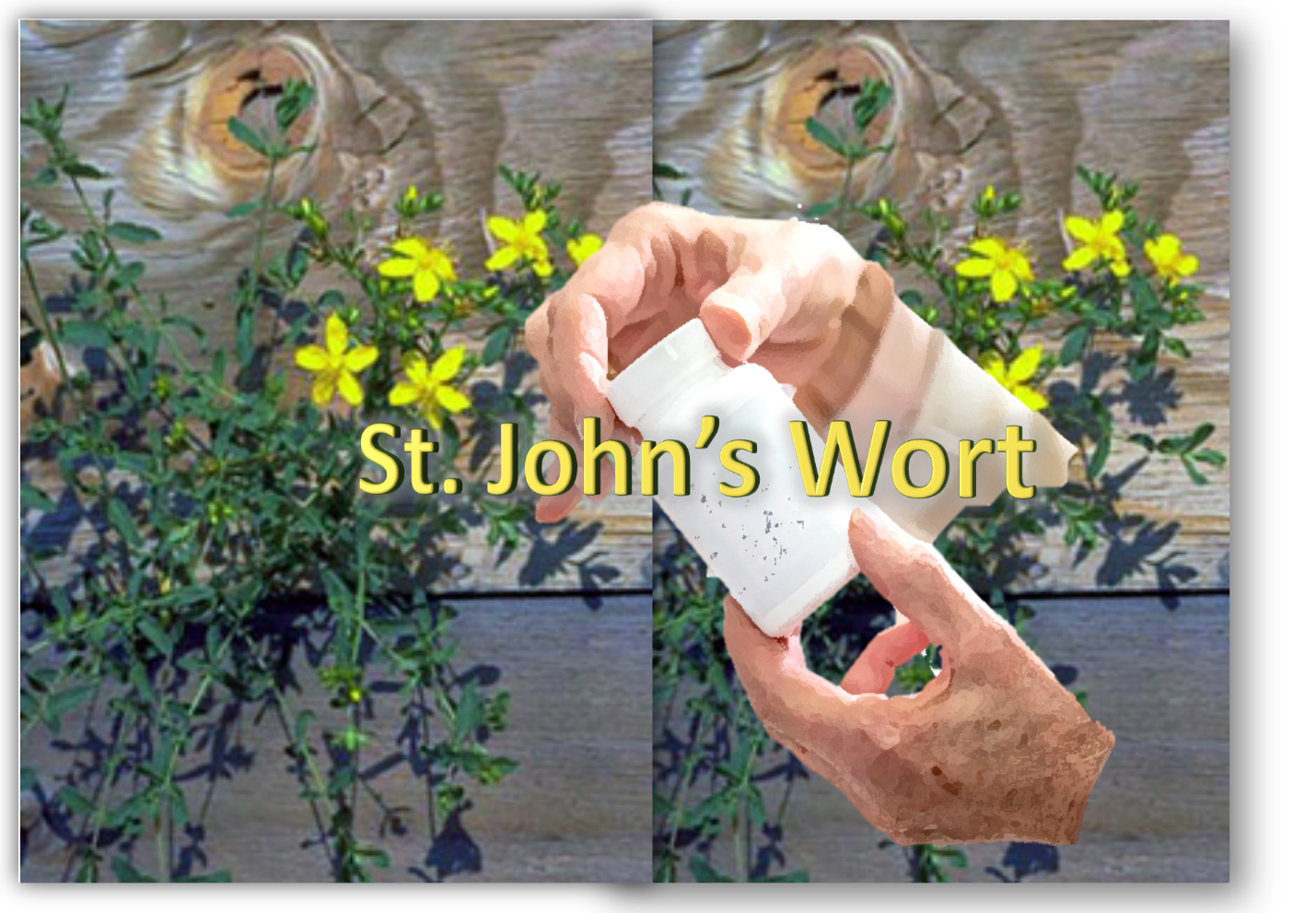
St. John’s wort (hypericum perforatum) is an effective antidepressant botanical medicine with fewer side-effects than the pharmaceuticals. 1, 2, 3, 4, 5, 6, 7, 8, 9, 10, 11, 12, 13
Clinical guidelines from the American College of Physicians state that “St. John’s wort may be as effective and better tolerated than conventional antidepressants for mild to moderate depression,” according to a peer-review report from an expert panel at NatMed Pro14, 15
It’s licensed and widely prescribed for depression in many European countries and is among the most well-researched medicinal herbs on the planet. Use of this botanical dates back to the ancient Greeks or earlier. St. John’s wort is used to treat depression in traditional Chinese medicine.
In people with major depression, St. John’s wort improves mood and insomnia, and it decreases anxiety and physical symptoms of depression like fatigue and changes in body weight or appetite, studies show. 16, 17, 18 , 19, 20, 21, 22
But this herb should come with a warning label due to its risk of potentially serious interactions with numerous drugs.
The herb’s propensity to interact with numerous medications limits its use for many people who regularly take certain prescription or over-the-counter medications.
The focus of scientific research on this herb has been on the use of St. John’s wort for depression. There’s a lack of research on its use in anxiety and insomnia.
Is it effective for insomnia in people without depression?

The herb has been found to improve insomnia in people with major depression. But there’s a lack of studies on the use of St. John’s wort for sleep in people without depression. Paradoxically, it can cause in insomnia as well as sedation.
St. John’s wort seems to improve menopausal symptoms including hot flashes. 23, 24 And it seems to improve sleep in women in perimenopause. 25
St. John’s wort may improve sleep quality in older people, one small study found. 26
How might the herb impact emotions & sleep?
St. John’s wort inhibits the reuptake of several neurotransmitters, including glutamate, norepinephrine, dopamine and the mood-hormone serotonin. 27, 28, 29, 30, 31, 32 And it works on other stress-hormone receptors called catecholamine receptors. 33 These effects drive an upsurge in the stress-hormone cortisol. 34

With all these stimulating actions, one might expect that St. John’s wort would defeat one’s ability to sleep and maintain calm. And indeed, insomnia and anxiety are possible side-effects of St. John’s wort. But this complex herb also inhibits reuptake of the neurotransmitter gamma-aminobutyric acid (GABA). 35 By enhancing GABA, St. John’s wort may have more of a calming effect like anti-anxiety drugs such as Xanax, which also enhance GABA.
Like selective serotonin reuptake inhibitor (SSRI) antidepressants such as Prozac, St. John’s wort also works on the serotonin system, possibly by acting on serotonin receptors rather than inhibiting reuptake of serotonin like the drugs. 36 Serotonin is part of how the body regulates both mood and sleep. Increased serotonin activity is thought to boost mood. But too much serotonin can cause anxiety.
With so many brain modulating effects, it’s very hard to guess at how the herb ultimately impacts anxiety and sleep.
Though research is clear on its effectiveness for mild-to-moderate depression, there’s still not enough research to know how St. John’s wort affects sleep, much less if it works to reduce insomnia.
There’s limited evidence suggesting St. John’s wort might improve sleep in women approaching menopause, 37 as well as women in menopause. 38
A randomized pilot study reported that taking St. John’s wort for 12 weeks decreased sleep problems compared with placebo (inert pills) in perimenopausal women. 39 But because St. John’s wort has been shown to reduce frequency and severity of hot flashes when compared with placebo 40, 41 and because hot flashes keep women awake at night, we can’t say if sleep would be improved in people not in menopause or perimenopause who do not have hot flashes.
The time we spend in deep sleep declines with age. St. John’s wort might improve deep sleep in older people. In a study of 12 older people, those who took St. John’s wort spent more time in deep, restorative sleep. But the study found the herb did not help people fall asleep or stay asleep.42 St. John’s wort could cause serious side effects in people with dementia.
Is it effective for anxiety?
The way St. John’s wort works is more complex than how drugs prescribed for anxiety like SSRI antidepressants and benzodiazepines drugs like Xanax work. But there is some overlap with how the pharmaceuticals work. Though St. John’s wort has an enhancing impact on gamma-aminobutyric acid (GABA)—the calming neurotransmitter—it also has very stimulating actions on stress hormones like cortisol and catecholamines. One of the side-effects of St. John’s wort is anxiety.
Though St. John’s wort helps improve anxiety in people with major depression, 43 taking this herb might not be helpful for those with social anxiety disorder who don’t have major depression.
St. John’s wort 600-1800 mg daily for 12 weeks did not improve social anxiety disorder or calm fears of social interactions when compared with placebo, a small study found. 44
More studies are needed to assess if this complex botanical medicine is helpful for anxiety.
To find out about St. John’s wort safety, drug interactions and side effects, click link below:
To find out how St. John’s wort stacks up against other supplements and pharmaceuticals, click link below:
To find out how to get the benefits of St. John’s wort, but avoid its side effects or drug interactions, click link below:
Care informed by the understanding that emotional and physical wellbeing are deeply connected
________________________________________________________________________________________________________________
By using MoodChangeMedicine.com, you agree to accept this website’s terms of use, which can be viewed here.
Citations
- Qaseem A, Barry MJ, Kansagara D, et al. “Nonpharmacologic versus pharmacologic treatment of adult patients with major depressive disorder: a clinical practice guideline from the American College of Physicians.” Ann Intern Med. 2016;164(5):350-9. View abstract. ↩︎
- Linde K, Berner MM, Kriston L: “St John’s wort for major depression.” Cochrane Database Syst Rev 2008;4: CD000448. ↩︎
- Canenguez Benitez JS, Hernandez TE, Sundararajan R, et al. “Advantages and Disadvantages of Using St. John’s Wort as a Treatment for Depression.” Cureus. 2022 Sep 22;14(9):e29468. doi: 10.7759/cureus.29468. PMID: 36299970; PMCID: PMC9587902. ↩︎
- Gastpar M, Singer A, Zeller K. “Comparative efficacy and safety of a once-daily dosage of hypericum extract STW3-VI and citalopram in patients with moderate depression: a double-blind, randomised, multicentre, placebo-controlled study.” Pharmacopsychiatry. 2006 Mar;39(2):66-75. doi: 10.1055/s-2006-931544. PMID: 16555167. Crossref PubMed Google Scholar ↩︎
- Ng QX, Venkatanarayanan N, Ho CY. “Clinical use of Hypericum perforatum (St John’s wort) in depression: A meta-analysis.” J Affect Disord. 2017 Mar 1;210:211-221. doi: 10.1016/j.jad.2016.12.048. Epub 2017 Jan 3. PMID: 28064110. ↩︎
- Szegedi A, Kohnen R, Dienel A, Kieser M. “Acute treatment of moderate to severe depression with hypericum extract WS 5570 (St. John’s wort): randomised controlled double blind non-inferiority trial versus paroxetine.” BMJ. 2005;330:503. [PMID: 15708844] Crossref PubMed Google Scholar ↩︎
- Brenner R, Azbel V, Madhusoodanan S, Pawlowska M. “Comparison of an extract of hypericum (LI 160) and sertraline in the treatment of depression: a double-blind, randomized pilot study.” Clin Ther. 2000;22:411-9. [PMID: 10823363] Crossref PubMed Google Scholar ↩︎
- Schrader E. “Equivalence of St. John’s wort extract (Ze 117) and fluoxetine: a randomized, controlled study in mild-moderate depression.” Int Clin Psychopharmacol. 2000;15:61-8. [PMID: 10759336] Crossref PubMed Google Scholar ↩︎
- Hypericum Depression Trial Study Group. “Effect of Hypericum perforatum (St. John’s wort) in major depressive disorder: a randomized controlled trial.” JAMA. 2002;287:1807-14. [PMID: 11939866] Crossref PubMed Google Scholar ↩︎
- Gastpar M, Singer A, Zeller K. “Efficacy and tolerability of hypericum extract STW3 in long-term treatment with a once-daily dosage in comparison with sertraline.” Pharmacopsychiatry. 2005;38:78-86. [PMID: 15744631] Crossref PubMed Google Scholar ↩︎
- Behnke K, Jensen GS, Graubaum HJ, Gruenwald J. “Hypericum perforatum versus fluoxetine in the treatment of mild to moderate depression.” Adv Ther. 2002;19:43-52. [PMID: 12008860] Crossref PubMed Google Scholar ↩︎
- Bjerkenstedt L, Edman GV, Alken RG, Mannel M. “Hypericum extract LI 160 and fluoxetine in mild to moderate depression: a randomized, placebo-controlled multi-center study in outpatients.” Eur Arch Psychiatry Clin Neurosci. 2005;255:40-7. [PMID: 15538592] Crossref PubMed Google Scholar ↩︎
- van Gurp G, Meterissian GB, Haiek LN, McCusker J, Bellavance F. “St. John’s wort or sertraline? Randomized controlled trial in primary care.” Can Fam Physician. 2002;48:905-12. [PMID: 12053635] PubMed Google Scholar ↩︎
- “St. John’s Wort Monograph” NatMed Pro Therapeutic Research Center database. current through 3/8/2024. Last modified on 3/7/2024. Accessed June, 2024. ↩︎
- Qaseem A, Barry MJ, Kansagara D, et al. “Nonpharmacologic versus pharmacologic treatment of adult patients with major depressive disorder: a clinical practice guideline from the American College of Physicians.” Ann Intern Med. 2016;164(5):350-9. View abstract. ↩︎
- Apaydin EA, Maher AR, Shanman R, et al. “A systematic review of St. John’s wort for major depressive disorder.” Syst Rev. 2016;5(1):148. View abstract. ↩︎
- Harrer G, Schmidt U, Kuhn U, Biller A. “Comparison of equivalence between the St. John’s wort extract LoHyp-57 and fluoxetine.” Arzneimittelforschung 1999;49:289-96. View abstract. ↩︎
- Linde K, Berner MM, Kriston L: “St John’s wort for major depression.” Cochrane Database Syst Rev. 2008;4: CD000448. ↩︎
- Linde K, Mulrow CD, Berner M, Egger M. S”t John’s Wort for depression.” Cochrane Database Syst Rev. 2005;(3):CD000448. View abstract. ↩︎
- Brenner R, Azbel V, Madhusoodanan S, Pawlowska M. “Comparison of an extract of hypericum (LI 160) and sertraline in the treatment of depression: a double-blind, randomized pilot study.” Clin Ther. 2000;22:411-9. [PMID: 10823363] Crossref PubMed Google Scholar ↩︎
- Szegedi A, Kohnen R, Dienel A, Kieser M. “Acute treatment of moderate to severe depression with hypericum extract WS 5570 (St. John’s wort): randomised controlled double blind non-inferiority trial versus paroxetine.” BMJ. 2005;330:503. [PMID: 15708844] Crossref PubMed Google Scholar ↩︎
- Schrader E. “Equivalence of St. John’s wort extract (Ze 117) and fluoxetine: a randomized, controlled study in mild-moderate depression.” Int Clin Psychopharmacol. 2000;15:61-8. [PMID: 10759336] Crossref PubMed Google Scholar ↩︎
- Grube B, Walper A, Wheatley D. “St. John’s Wort extract: efficacy for menopausal symptoms of psychological origin.” Adv Ther. 1999 Jul-Aug;16(4):177-86. PMID: 10623319. ↩︎
- Liu YR, Liang YL, Huang RD, et al. “Hypericum perforatum preparations L. preparations for menopause: a meta-analysis of efficacy and safety.” Climacteric 2014;17:325-335. View abstract. ↩︎
- Liu YR, Liang YL, Huang RD, et al. “Hypericum perforatum preparations L. preparations for menopause: a meta-analysis of efficacy and safety.” Climacteric 2014;17:325-335. View abstract. ↩︎
- Schulz H, Jobert M. “Effects of hypericum extract on the sleep EEG in older volunteers.” J Geriatr Psychiatry Neurol. 1994 Oct;7 Suppl 1:S39-43. doi: 10.1177/089198879400700111. PMID: 7857507. ↩︎
- Vance KM, Ribnicky DM, Hermann GE, Rogers RC. “St. John’s Wort enhances the synaptic activity of the nucleus of the solitary tract. Nutrition.” 2014 Jul-Aug;30(7-8 Suppl):S37-42. doi: 10.1016/j.nut.2014.02.008. Epub 2014 Feb 28. PMID: 24985104; PMCID: PMC4128486. ↩︎
- Jensen AG, Hansen SH, Nielsen EO. “Adhyperforin as a contributor to the effect of Hypericum perforatum L. in biochemical models of antidepressant activity.” Life Sci. 2001;68:1593-605. View abstract. ↩︎
- Wonnemann M, Singer A, Müller WE. Inhibition of synaptosomal uptake of 3H-L-glutamate and 3H-GABA by hyperforin, a major constituent of St. John’s Wort: the role of amiloride sensitive sodium conductive pathways. Neuropsychopharmacology. 2000 Aug;23(2):188-97. doi: 10.1016/S0893-133X(00)00102-0. PMID: 10882845. ↩︎
- Bhattacharya, S. K., Chakrabarti, A., and Chatterjee, S. S. “Activity profiles of two hyperforin-containing hypericum extracts in behavioral models.” Pharmacopsychiatry 1998;31 Suppl 1:22-29. View abstract. ↩︎
- Muller WE, Singer A, Wonnemann M, et al. “Hyperforin represents the neurotransmitter reuptake inhibiting constituent of hypericum extract.” Pharmacopsychiatry. 1998;31:16-21. View abstract. ↩︎
- Schule C, Baghai T, Ferrera A, Laakmann G. “Neuroendocrine effects of Hypericum extract WS 5570 in 12 healthy male volunteers.” Pharmacopsychiatry. 2001;34:S127-33. View abstract. ↩︎
- Bhattacharya, S. K., Chakrabarti, A., and Chatterjee, S. S. “Activity profiles of two hyperforin-containing hypericum extracts in behavioral models.” Pharmacopsychiatry. 1998;31 Suppl 1:22-29. View abstract. ↩︎
- Schule C, Baghai T, Ferrera A, Laakmann G. “Neuroendocrine effects of Hypericum extract WS 5570 in 12 healthy male volunteers.” Pharmacopsychiatry. 2001;34:S127-33. View abstract. ↩︎
- Wonnemann M, Singer A, Müller WE. Inhibition of synaptosomal uptake of 3H-L-glutamate and 3H-GABA by hyperforin, a major constituent of St. John’s Wort: the role of amiloride sensitive sodium conductive pathways. Neuropsychopharmacology. 2000 Aug;23(2):188-97. doi: 10.1016/S0893-133X(00)00102-0. PMID: 10882845. ↩︎
- Chatterjee SS, Noldner M, Koch E, Erdelmeier C. “Antidepressant activity of hypericum perforatum and hyperforin: the neglected possibility.” Pharmacopsych. 1998;31:7-15. View abstract. ↩︎
- Al-Akoum M., Maunsell E., Verreault R., Provencher L., et. al. “Effects of Hypericum perforatum (St. John’s wort) on hot flashes and quality of life in perimenopausal women: a randomized pilot trial.” Menopause. 2009;16(2):307–314. doi: 10.1097/gme.0b013e31818572a0. [PubMed] [CrossRef] [Google Scholar] ↩︎
- Liu YR, Liang YL, Huang RD, et al. “Hypericum perforatum preparations L. preparations for menopause: a meta-analysis of efficacy and safety.” Climacteric 2014;17:325-335. View abstract. ↩︎
- Al-Akoum M., Maunsell E., Verreault R., Provencher L., et. al. “Effects of Hypericum perforatum (St. John’s wort) on hot flashes and quality of life in perimenopausal women: a randomized pilot trial.” Menopause. 2009;16(2):307–314. doi: 10.1097/gme.0b013e31818572a0. [PubMed] [CrossRef] [Google Scholar] ↩︎
- Al-Akoum M., Maunsell E., Verreault R., Provencher L., et. al. “Effects of Hypericum perforatum (St. John’s wort) on hot flashes and quality of life in perimenopausal women: a randomized pilot trial.” Menopause. 2009;16(2):307–314. doi: 10.1097/gme.0b013e31818572a0. [PubMed] [CrossRef] [Google Scholar] ↩︎
- Liu YR, Liang YL, Huang RD, et al. “Hypericum perforatum preparations L. preparations for menopause: a meta-analysis of efficacy and safety.” Climacteric 2014;17:325-335. View abstract. ↩︎
- Schulz H, Jobert M. “Effects of hypericum extract on the sleep EEG in older volunteers.” J Geriatr Psychiatry Neurol. 1994 Oct;7 Suppl 1:S39-43. doi: 10.1177/089198879400700111. PMID: 7857507. ↩︎
- Linde K, Berner MM, Kriston L: “St John’s wort for major depression.” Cochrane Database Syst Rev. 2008;4: CD000448. ↩︎
- Kobak, K. A., Taylor, L. V., Warner, G., and Futterer, R. St. “John’s wort versus placebo in social phobia: results from a placebo-controlled pilot study.” J.Clin Psychopharmacol. 2005;25(1):51-58. View abstract. ↩︎

 Mood Change Medicine
Discussion
No comments yet.