By using MoodChangeMedicine.com, you agree to accept this website’s terms of use, which can be viewed here.
By Joie Meissner ND, BCB-L
Mood Change Medicine uses Biofeedback-Assisted Relaxation Training (BART) to support gold-standard insomnia therapy, lower stress and to address the biological drivers of anxiety and depression.
BART—a powerful, time-tested therapy—helps you shift your physiology from a stressed state to a relaxed and balanced one. This is one of the ways BART supports your efforts to break free from destructive, anxious and depressive thought patterns.
Relaxation therapies like BART improve depression, anxiety, phobia, and worry, numerous studies show. 1, 2, 3, 4, 5, 6
Using biofeedback, you learn to shift your body into a calmer state—called the rest-digest-repair (parasympathetic) response. A calm state facilitates the positive realignment of your emotions and thinking.
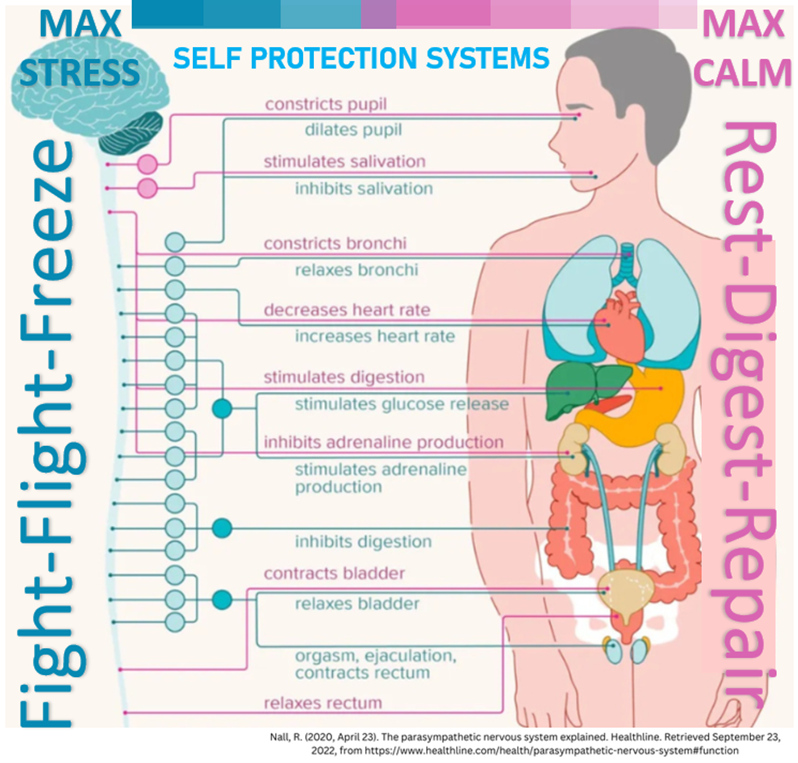
When we are stressed, anxious or depressed, our body makes stress hormones that generate inflammation and can worsen mental and physical health. When we calm ourselves with the help of BART, it reduces inflammation created by our stress biology—called the fight-or-flight (sympathetic) response. Stress and resulting stress hormones like cortisol have a negative impact on sleep, anxiety and depression. 7, 8, 9, 10, 11, 12
Stressed biology makes us more prone to stressed thinking and stressed emotions like worry, fear and despair. When our physiology is stressed, it makes it more likely that we will engage in behaviors that promote a vicious cycle of even more stressed biology, stressed thinking and stressed emotions.
Mood Change Medicine uses biofeedback to boost the efficacy of Cognitive Behavioral Therapy (CBT)—a principal anxiety and depression treatment, which has been shown to deactivate threat centers in the brain including reducing the physical size of brain structures that activate stress, inflammation, anxiety and depression. 13, 14, 15, 16
Mood Change Medicine incorporates all the components of traditional Cognitive Behavioral Therapy for Insomnia (CBT-I) plus Biofeedback-Assisted Relaxation Therapy to treat insomnia. This combined treatment modality is used in sleep treatment programs of prestigious health care systems like the Cleveland Clinic’s CBT-I program, and the Mayo Clinic’s program “Insomnia treatment: Cognitive behavioral therapy instead of sleeping pills.”
Heart rate variability (HRV) biofeedback, a form of biofeedback-assisted relaxation training, can help anxiety, sleeplessness and depression by teaching us to voluntarily shift our physiological responses out of the stressed state of fight-flight and into the calm state of rest-digest-repair.
Heart rate variability biofeedback has been shown to lower levels of the stress hormone-cortisol. 17 HRV can reduce levels of stress, anxiety, depressive symptoms and thinking patterns and promote psychological well-being. 18, 19, 20, 21
“Adding HRV biofeedback to psychotherapy can augment treatment effects in various mental disorders,” according to a 2022 review of studies on HRV. 22 HRV biofeedback teaches people to increase the variability of their heart rate, a sign of health which is thought to reflect resilience and behavioral flexibility.
Biofeedback is known for its ability to help train people to do basic self-regulation methods, which is the ability to consciously monitor and adjust one’s physiological and psychological states to achieve reduced stress, improved focus and emotional balance.
By reducing the effects of stress on the mind and body, BART helps you cultivate a greater sense of well-being.
To learn more about how biofeedback helps defeat anxiety and depression, click link: How to De-Stress Your Way Out of Anxiety and Depression
How Biofeedback Works
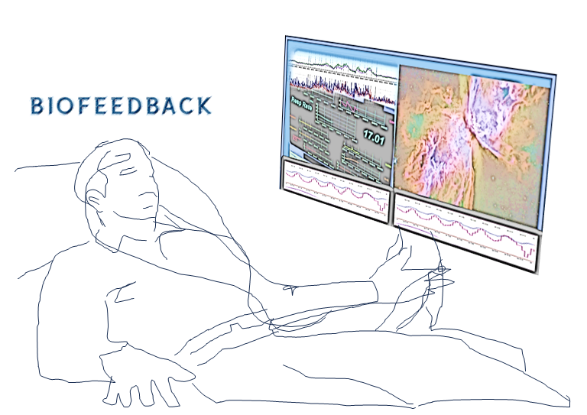
Using safe, non-invasive physiological sensors, biofeedback shows how your physiology changes, in real time, on a computer screen. You will hear audio tones and see pictures, animations or graphs that change as your body changes. This allows you to monitor and adjust your physiology into a more relaxed state and out of the stressed, fight-or-flight state that ignites, inflames and maintains depression and anxiety.

The process of monitoring images and sound generated by biofeedback equipment to reflect your physiology allows the person to:
- Become aware of automatic reactions to stressors.
- Link physiological changes with the ways we think and feel.
- Learn to change internal physiological states using various mental strategies and relaxation techniques in order to help shift our minds into a more positive emotional state.
- Gain the ability to recognize automatic and undesirable physiological reactions to stressful situations and override them with practiced, self-regulation skills.
Biofeedback shows us how our nervous system responds to different therapeutic interventions including relaxation techniques. It does this by showing us parts of our stress biology that we are normally unaware of such as muscle tension, hand temperature, heart and respiration rate, and galvanic skin response.
Each person’s physiological response to stressors differs. For example, some people respond more with changes in hand temperature and some respond more with changes in muscle tension or breathing.
Using biofeedback technology, we can become aware of elevated shoulder muscle tension and learn how to voluntarily relax upper-body muscles thus releasing stress and tension. BART can be used to teach us how to breathe in ways that help lower stress and boost our relaxation response.
BART combines the stress-reducing power of biofeedback technology with a range of relaxation techniques.
The physiological relaxation profile uses biofeedback technology to help you determine which technique works best to shift your body into a calmer state, the rest-digest-repair or parasympathetic state.
Just as there are individual differences in how each person’s body responds to stressors, we each have unique physiological responses to different stress-reducing techniques. That’s why Mood Change Medicine assesses your body’s responses to a variety of relaxation techniques using a physiological relaxation profile.
Many of the relaxation techniques we’ll use in your session are discussed in the Stress Reduction Toolbox handout. All the techniques can help to shift your body into that calm, relaxed and balanced state that helps you make the changes that help you move forward with your therapy goals.
A number of the tools in the Stress Reduction Toolbox have huge benefits for mental and physical health beyond improvement of mood, stress, anxiety and sleep. Examples include resonant frequency breathing, slow diaphragmatic breathing, mindfulness practices, progressive muscle relaxation, autogenic training, guided imagery and hypnosis. Many of the tools we’ll use in your biofeedback session are listed in the toolbox handout.
Biofeedback technology measures physiological changes in your body. It is not something that is done to you, it’s something that gives you information about what your body is doing in real-time. The electronics are simply like mirrors that give us information. The information displayed by the electronics is only half the story. You play an active role in the process. We go by what feels the most relaxing and works best for you.
Click link below for more on how biofeedback can help you break free of anxiety and depression:
Care informed by the understanding that emotional and physical wellbeing are deeply connected
________________________________________________________________________________________________________________
By using MoodChangeMedicine.com, you agree to accept this website’s terms of use, which can be viewed here.
Citations
- “Relaxation Therapy Monograph” NatMedPro Therapeutic Research Center database. 1/14/2022 last modified 3/31/2022., accessed March 2024 ↩︎
- Gagne D, Toye RC. “The effects of therapeutic touch and relaxation therapy in reducing anxiety.” Arch Psychiatr Nurs. 1994;8(3):184-9. View abstract. ↩︎
- Manzoni GM, Pagnini F, Castelnuovo G, Molinari E. “Relaxation training for anxiety: a ten-years systematic review with meta-analysis.” BMC Psychiatry. 2008;8:41. View abstract. ↩︎
- Kim HS, Kim EJ. “Effects of Relaxation Therapy on Anxiety Disorders: A Systematic Review and Meta-analysis.” Arch Psychiatr Nurs. 2018;32(2):278-284. View abstract. ↩︎
- Ibrahim A, Koyuncu G, Koyuncu N, Suzer NE, Cakir OD, Karcioglu O. “The effect of Benson relaxation method on anxiety in the emergency care.” Medicine (Baltimore). 2019;98(21):e15452. View abstract. ↩︎
- Zenouzi A, Moghadam ZB, Babayanzad S, Asghari M, Rezaei E. “The effect of Benson relaxation technique on stress, anxiety, and depression in pregnant women.” Holist Nurs Pract 2021. View abstract ↩︎
- Miao Z, Wang Y, Sun Z. “The Relationships Between Stress, Mental Disorders, and Epigenetic Regulation of BDNF.” Int J Mol Sci. 2020 Feb 18;21(4):1375. doi: 10.3390/ijms21041375. PMID: 32085670; PMCID: PMC7073021. ↩︎
- Hassamal, Sameer. “Chronic stress, neuroinflammation, and depression: an overview of pathophysiological mechanisms and emerging anti-inflammatories.” Front. Psychiatry. 10 May 2023. Sec. Molecular Psychiatry Volume 14 – 2023. frontiersin.psychiatry/10.3389. ↩︎
- Hu P, Lu Y, Pan BX, Zhang WH. “New Insights into the Pivotal Role of the Amygdala in Inflammation-Related Depression and Anxiety Disorder.” Int J Mol Sci. 2022 Sep 21;23(19):11076. doi: 10.3390/ijms231911076. PMID: 36232376; PMCID: PMC9570160. ↩︎
- Dzierzewski JM, Donovan EK, Kay DB, Sannes TS, Bradbrook KE. Sleep Inconsistency and Markers of Inflammation. Front Neurol. 2020 Sep 16;11:1042. doi: 10.3389/fneur.2020.01042. PMID: 33041983; PMCID: PMC7525126. https://www.ncbi.nlm.nih.gov/pmc/articles/PMC7525126/ ↩︎
- Irwin MR, Olmstead R, Carroll JE. “Sleep Disturbance, Sleep Duration, and Inflammation: A Systematic Review and Meta-Analysis of Cohort Studies and Experimental Sleep Deprivation.” Biol Psychiatry. 2016;80:40‐52. [PMC free article] [PubMed] [Google Scholar] ↩︎
- Berk M, Williams LJ, Jacka FN, O’Neil A, et al. “So depression is an inflammatory disease, but where does the inflammation come from?” BMC Med. 2013 Sep 12;11:200. doi: 10.1186/1741-7015-11-200. PMID: 24228900; PMCID: PMC3846682. ↩︎
- Hu P, Lu Y, Pan BX, Zhang WH. “New Insights into the Pivotal Role of the Amygdala in Inflammation-Related Depression and Anxiety Disorder.” Int J Mol Sci. 2022 Sep 21;23(19):11076. doi: 10.3390/ijms231911076. PMID: 36232376; PMCID: PMC9570160. ↩︎
- Månsson KN, Salami A, Frick A, Carlbring P, Andersson G, Furmark T, Boraxbekk CJ. “Neuroplasticity in response to cognitive behavior therapy for social anxiety disorder.” Transl Psychiatry. 2016 Feb 2;6(2):e727. doi: 10.1038/tp.2015.218. PMID: 26836415; PMCID: PMC4872422. ↩︎
- Appelbaum, L.G., Shenasa, M.A., Stolz, L. et al. “Synaptic plasticity and mental health: methods, challenges and opportunities.” Neuropsychopharmacol. 48, 113–120 (2023). nature.com ↩︎
- DeRubeis RJ, Siegle GJ, Hollon SD. “Cognitive therapy versus medication for depression: treatment outcomes and neural mechanisms.” Nat Rev Neurosci. 2008 Oct;9(10):788-96. doi: 10.1038/nrn2345. Epub 2008 Sep 11. PMID: 18784657; PMCID: PMC2748674. ↩︎
- Makaracı Y, Makaracı M, Zorba E, Lautenbach F. “A Pilot Study of the Biofeedback Training to Reduce Salivary Cortisol Level and Improve Mental Health in Highly-Trained Female Athletes.” Appl Psychophysiol Biofeedback. 2023 Sep;48(3):357-367. doi: 10.1007/s10484-023-09589-z. Epub 2023 May 19. PMID: 37204539. ↩︎
- Goessl VC, Curtiss JE, Hofmann SG. “The effect of heart rate variability biofeedback training on stress and anxiety: a meta-analysis.” Psychol Med. 2017 Nov;47(15):2578-2586. doi: 10.1017/S0033291717001003. Epub 2017 May 8. PMID: 28478782. ↩︎
- Herhaus B, Siepmann M, Kahaly G, Conrad R, Petrowski K. “Effect of a biofeedback intervention on heart rate variability in individuals with panic disorder: A randomized controlled trial.” Psychosomatic Medicine. 2022;84(2):199–209. doi: 10.1097/PSY.0000000000001031. [PubMed] [CrossRef] [Google Scholar] ↩︎
- Schumann A, Helbing N, Rieger K, Suttkus S, Bär KJ. “Depressive rumination and heart rate variability: A pilot study on the effect of biofeedback on rumination and its physiological concomitants.” Front Psychiatry. 2022 Aug 25;13:961294. doi: 10.3389/fpsyt.2022.961294. PMID: 36090366; PMCID: PMC9452722. ↩︎
- Pizzoli SFM, Marzorati C, Gatti D, Monzani D, Mazzocco K, Pravettoni G. “A meta-analysis on heart rate variability biofeedback and depressive symptoms.” Sci Rep. 2021 Mar 23;11(1):6650. doi: 10.1038/s41598-021-86149-7. PMID: 33758260; PMCID: PMC7988005. ↩︎
- Siepmann M, Weidner K, Petrowski K, Siepmann T. “Heart Rate Variability: A Measure of Cardiovascular Health and Possible Therapeutic Target in Dysautonomic Mental and Neurological Disorders.” Appl Psychophysiol Biofeedback. 2022 Dec;47(4):273-287. doi: 10.1007/s10484-022-09572-0. Epub 2022 Nov 22. PMID: 36417141; PMCID: PMC9718704. ↩︎

 Mood Change Medicine
Discussion
No comments yet.